Lights, Learning, Action: A Filmmaker’s Journey Collaborating on a Science Documentary
April 2026
By David Busse
From Uncertainty to Opportunity
When I arrived at the Horwitz-DeRemer Planetarium in December 2024, I thought my film idea wouldn’t work. Previously, another planetarium professional discouraged me, and work at my day job was so busy that we had rescheduled our meeting three times. I thought this trip would end with everyone deciding against the idea. Nonetheless, I made my way to meet with Lisa Swaney, the planetarium’s director. She and her team invited me into the planetarium to share a variety of their films. We talked about their characteristics, styles, and genres, licensing, and the unique needs of planetariums. Then, they played my film. It was still in its infancy, filmed for standard screens, seeing it blown up in a domed theater gave me equal parts excitement and wariness. Could I convert my project so it can be shown in planetariums, and did it make sense in this space? I wasn’t sure. But Lisa assured me that she would love to see my film shown in planetariums and would be happy to share it with students.
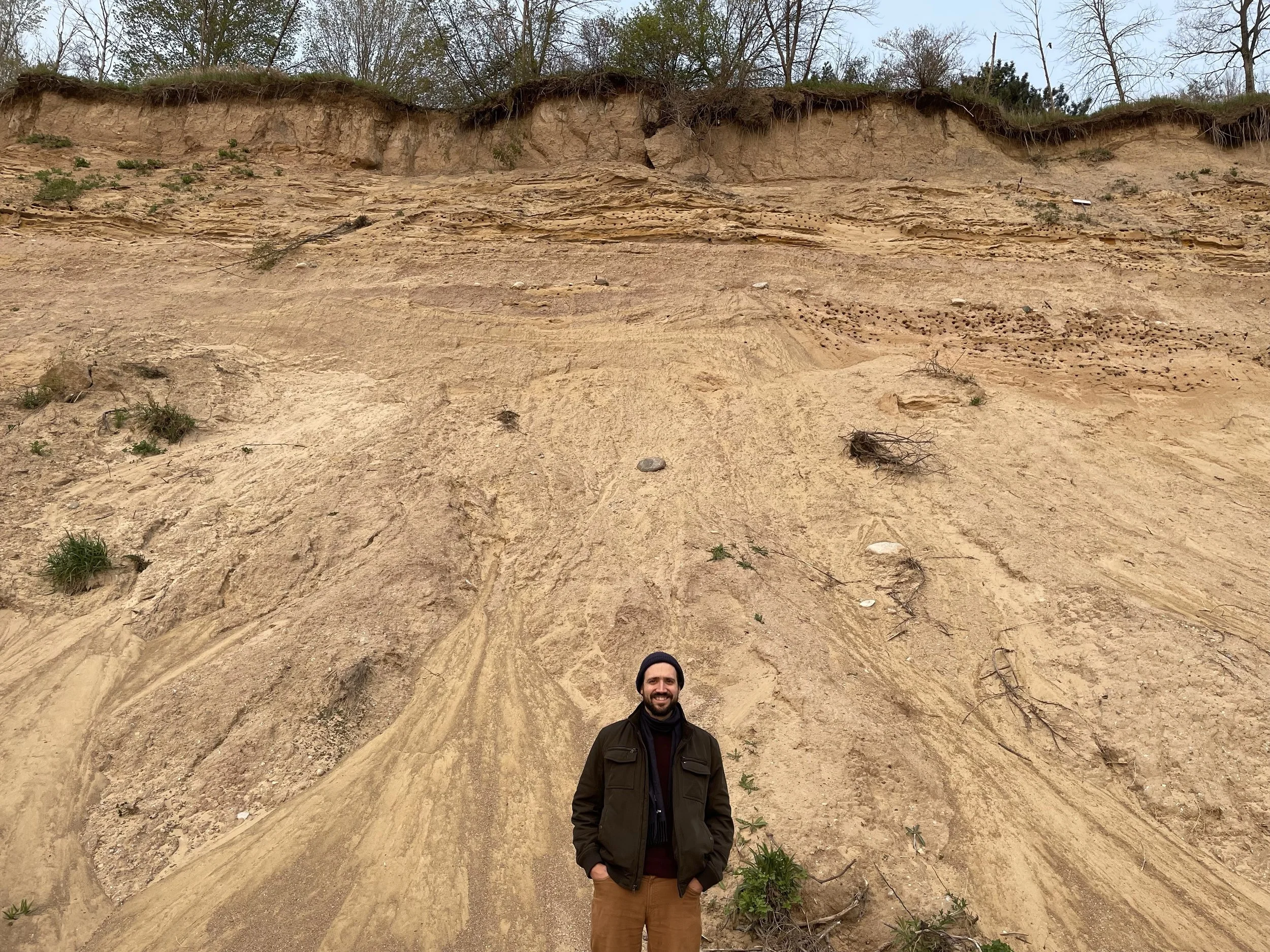
Me standing in front of the bluffs of Lake Michigan, where the project was filmed.
I wasn’t thinking about creating something for classrooms; I was following my curiosity. Now, hearing Lisa, a former biology teacher who directs the planetarium housed at the Retzer Nature Center, enthusiastically embrace my film was a turning point. I had found an audience for my film, and one that meant my work could have a home for years to come. In the months that followed, I would meet with Lisa to talk through the film. Like most educators, Lisa does many things in her role, including fundraising, managing operations and staff, organizing school trips, and curating the shows played at the planetarium. This early support and dedication from someone with so many other priorities helped me to believe in my film.
Curiosity, Research, and Collaboration
Back in 2023, well before meeting Lisa, I had unexpectedly become something of a citizen scientist. I’d discovered colonies of thousands of bank swallows swirling over Lake Michigan, going to and from the bluffs in what looked like absolute chaos. I’d uncovered something wonderful hidden in plain sight. Feeling compelled to capture it, I began observing them whenever I had the chance and ended up filming their entire life cycle. Countless nights were spent combing through hour upon hour of slow-motion footage, trying to understand their behaviors, reading articles from Scientific American, research papers from 100 years ago, and signing up for a monthly subscription to eBird to read their species page. I was in deep and over my head.
Then one day, I stumbled upon a research paper titled “The Hawk-Eyed Songbird: Retinal Morphology, Eye Shape, and Visual Fields of an Aerial Insectivore”. The paper was dense. I had to read it about three times before I felt I was beginning to understand! It discussed ideas about having longer eyes for better magnification, a relatively large blind spot, narrow binocular vision, and four distinct focal points. Their world was becoming increasingly alien to the one I knew. It was like we existed in alternate dimensions. I appreciated not just what they’d discovered, but also how meticulously their arguments were built on a foundation of citations; an insight into science that I appreciated more than my last time in a biology classroom 20 years prior. I realized I needed help contextualizing the research and ensuring I was deciphering it correctly.
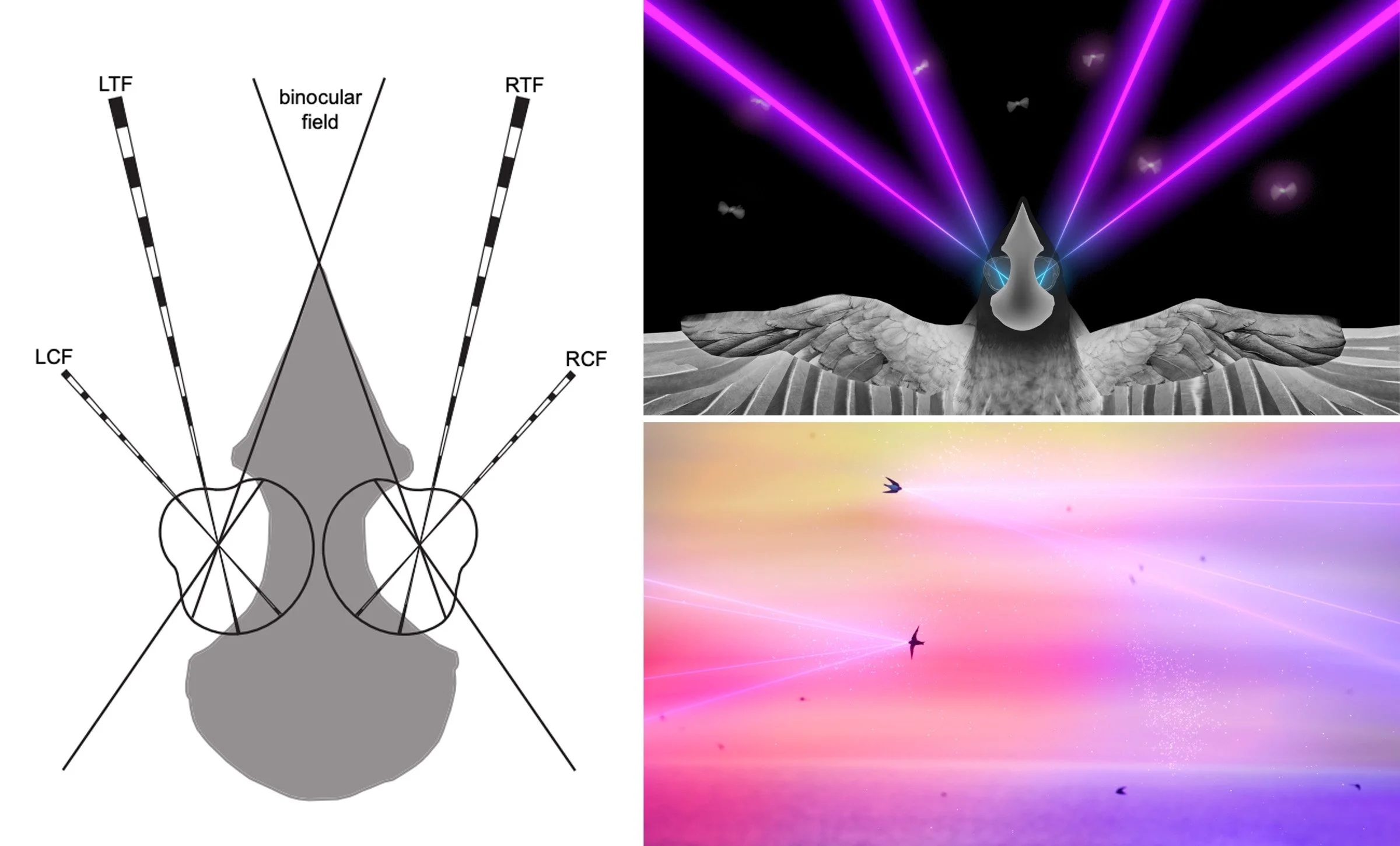
Illustration from Dr. Tyrrell’s research paper showing a swallow’s four foveae and binocular field (left), stills from the film showing an artist's representation of the four foveae and how they are used to hunt.
So, I decided to reach out to one of the paper’s authors, Dr. Luke Tyrrell. I was nervous sending that initial email and unsure if I would get a response. Plus, having gone to film school, I felt intimidated about cold emailing someone with a PhD. Fortunately, Dr. Tyrrell got back to me, and he answered all my questions in detail. I felt grateful to have found someone so willing to share their knowledge, and even more fascinated by the depth of their answers. It also made me realize how carefully I would need to craft my script to balance accuracy with the brevity required for a film. Our conversation continued over the next year until I had exhausted all of my questions and felt I understood the bank swallow. These conversations gave me a deeper appreciation for both our natural world and the incredible work that goes into the scientific process. In turn, I tried my best to incorporate that sense of wonder.
Then, in the Fall of 2024, in the middle of all of this, I found myself at the Retzer Nature Center watching a show at the Horwitz-DeRemer Planetarium. On a whim, I approached the planetarium staff afterward and asked whether they would be interested in hosting a local nature documentary. That staff member said yes, and that’s how I met Lisa Swaney.
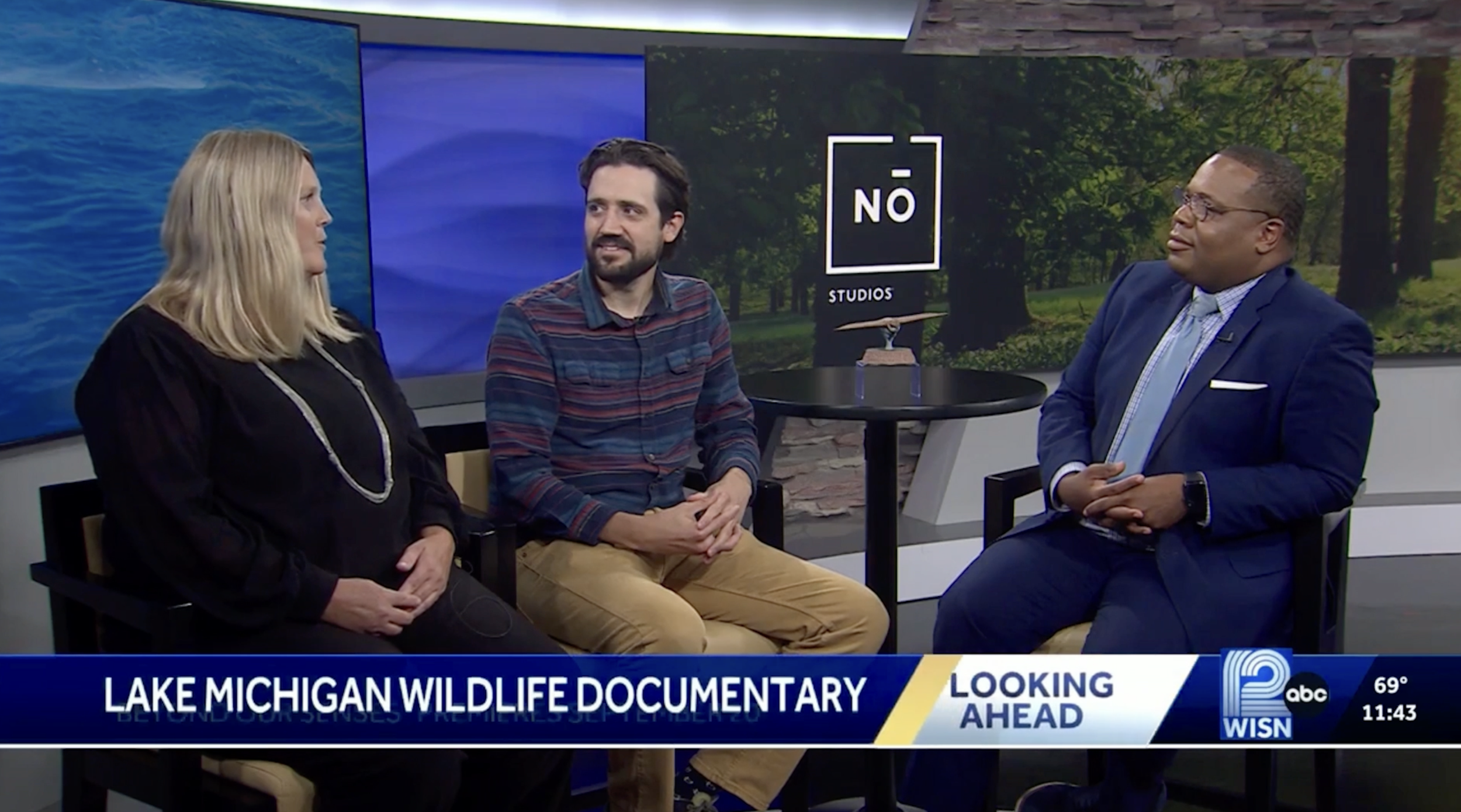
Lisa and I appeared on the local news to promote the film and the Horwitz-DeRemer Planetarium,
Bringing the Film to Life
Over the next year, I worked with Lisa and her team to format my film for planetariums. As the film developed, she became a sounding board to help guide it and ensure it could help students learn about our world. During this process, I attended a planetarium conference where I met other institutions interested in screening the film, and I found another educator who said yes and helped me create Next Generation Science Standards (NGSS) aligned materials to support the film in classrooms.
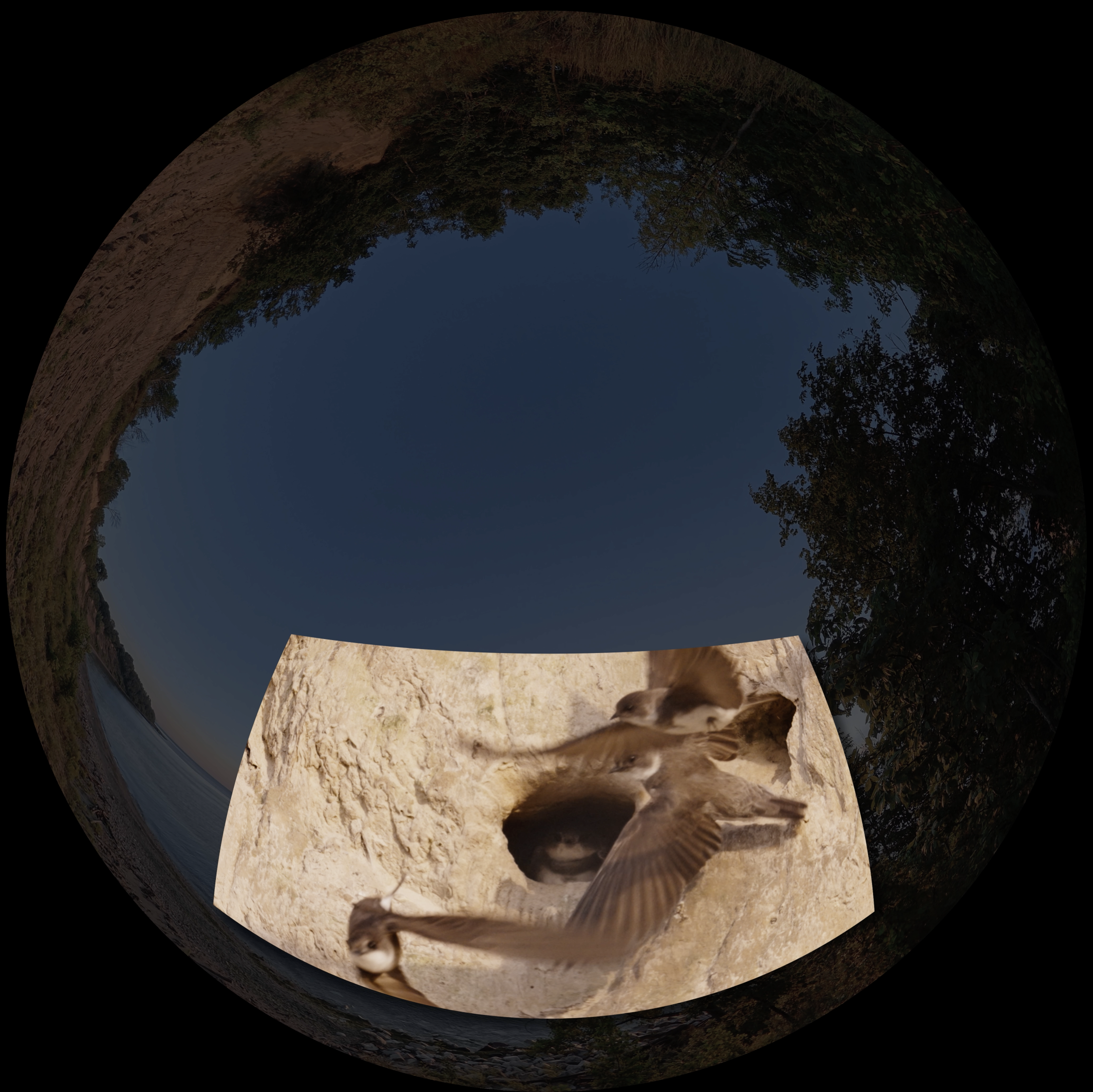
Still from the planetarium version of the film, showing how the standard footage was warped, and footage of the bluffs was added to the background to fill in the screen.
Now I have a 30-minute nature documentary and science education program about a beautiful phenomenon along the shores of Lake Michigan, fact-checked by a scientist and supported by many educators. My documentary is called “Beyond Our Senses: Bank Swallows,” and I couldn’t be happier that I followed my curiosity. In my experience, every time I heard ‘yes,’ it enabled me to continue this journey and ultimately create something I hope will illuminate the wonders of our world for students of all ages.
If you work in education, I encourage you to reflect on the role you play in your community and the effect you can have by saying yes to yourself and others. Like many people, I’ve had plenty of ideas that never got off the ground because of doubts and obstacles I thought existed. I’m glad that I pushed through and thankful for the educators who helped along the way. If you are ever near Waukesha, check out the Horwitz-DeRemer Planetarium, whose mission is “to ignite curiosity and wonder about the universe in which we live, all while connecting us to our natural world under the sky we share.”
David Busse biography
David Busse is a guest contributor and the creator of Beyond Our Senses: Bank Swallows, a 30-minute nature documentary about the life and perceptions of the bank swallow. The film is available for planetariums and standard screens. NGSS-aligned educational materials are available with it. You can find screening times, request screenings, and learn more at beyondoursensesfilm.com.
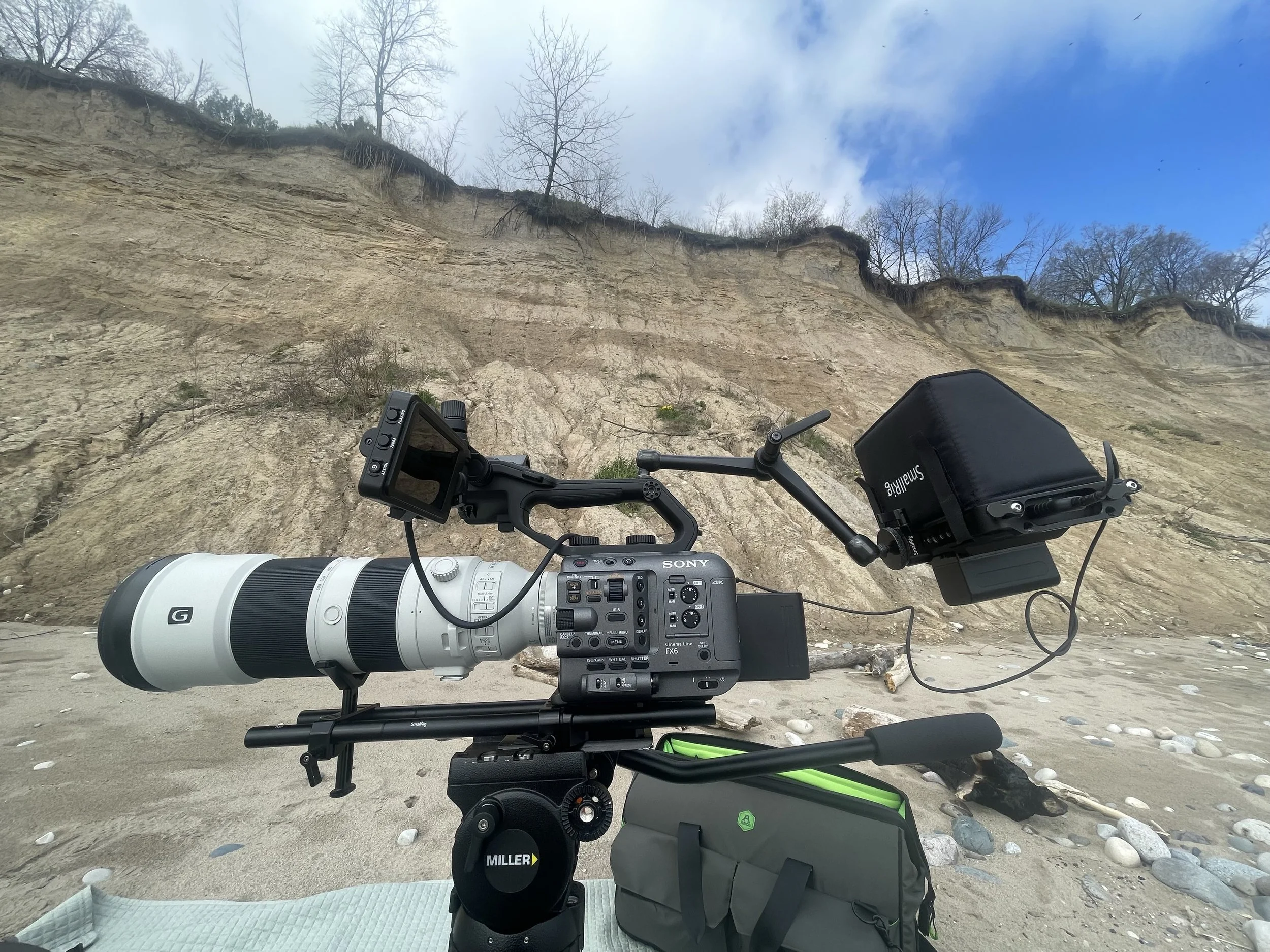
The camera I used to film the documentary. Sony FX6 with 200-600mm lens, 1.4x extender, 5” monitor, and accessories.
Posted April 2026 by Maureen Haeger, Marketing Communications & Program Manager, STEM Forward.
